What Is an All-in-One Business Management Platform? (And Does Your Business Need One?)
TL;DR
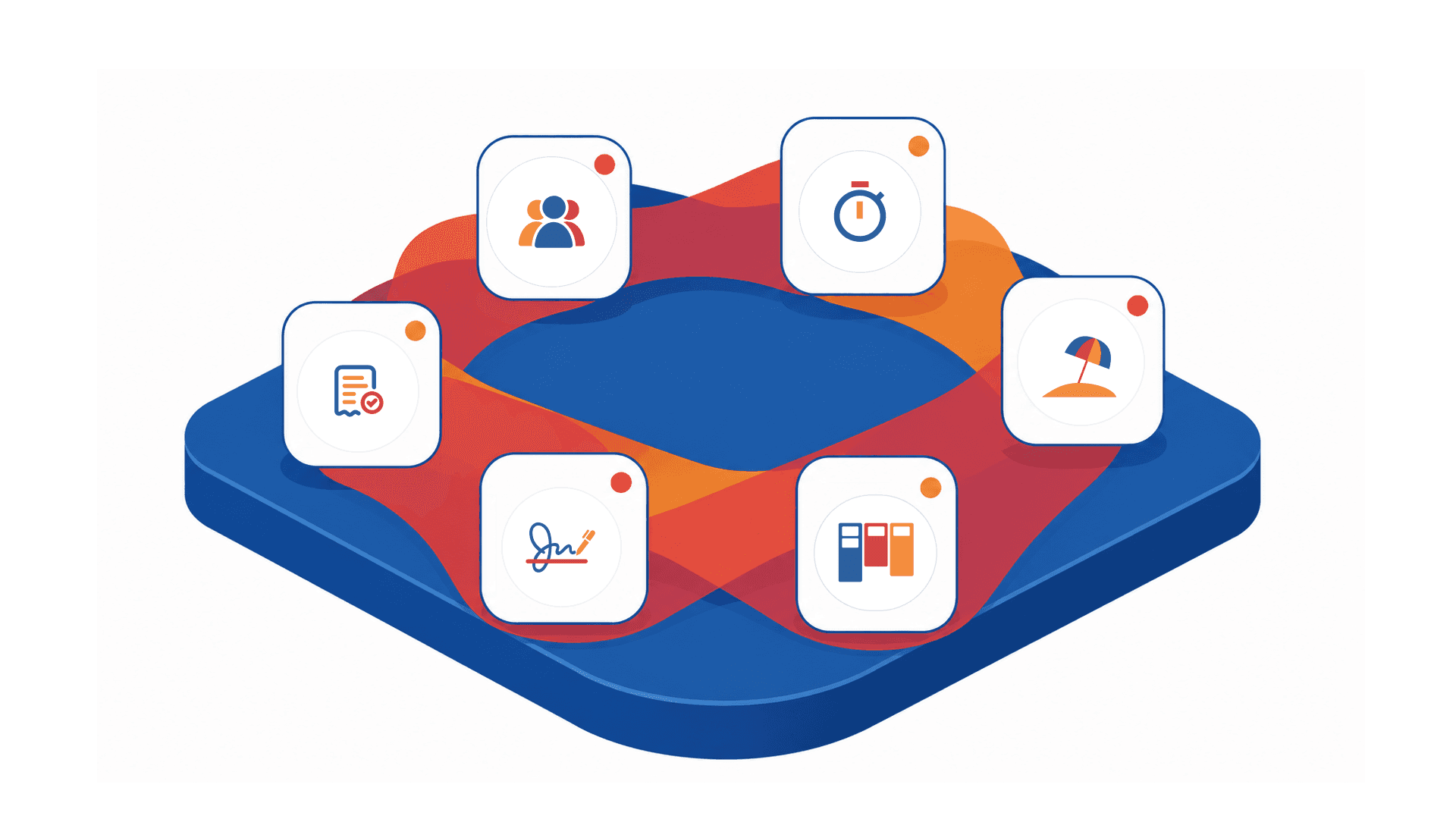
An all-in-one business management platform combines HR, leave management, time tracking, project management, document signing, and invoicing into a single connected system where data flows between functions without manual effort. The main benefits are lower software costs, less administrative overhead, and more consistent data across the business. These platforms work best for growing and mid-sized teams managing several disconnected tools. Skapp is one example, covering all of these functions in one environment starting at USD 5 per user per month on the Core plan, with a free plan for teams of up to 10 users. Most businesses do not set out to build a complicated software stack. It starts with one tool for project management, then another for HR, then one more for leave tracking, a separate one for document signing, and eventually a billing platform that does not connect to any of the others. Each addition made sense at the time, but over months and years, the result is a collection of disconnected tools that require separate logins, separate training, separate subscriptions, and a significant amount of manual effort just to keep the data consistent between them. An all-in-one business management platform is the alternative to that approach. Instead of managing five or six separate tools, a single platform covers multiple operational functions in one connected environment. This article explains what that actually means, what these platforms typically cover, what the real advantages are, and how to know whether your business would benefit from making the switch.
What an All-in-One Platform Actually Is
An all-in-one business management platform is a software product that combines several core business functions into a single system. Rather than buying and managing separate tools for HR, project management, time tracking, invoicing, and document signing, a business uses one platform that handles all of these functions and shares data between them.
The key word is connected. The value of an all-in-one platform is not just that multiple tools are bundled together, but that the data from each function informs the others. An employee's leave record is visible when planning project timelines. Hours logged against tasks can flow directly into client invoices. A new hire's profile is created once and connected to everything else from day one. This kind of connectivity is what separates a genuine all-in-one platform from a collection of loosely integrated tools that happen to share a login.
What These Platforms Typically Cover
The specific modules vary between platforms, but most all-in-one business management platforms cover some combination of the following.
People and HR Management is usually the foundation. This covers employee profiles, organisational structure, job roles, and employment history. A good HR module gives teams a single searchable record for every employee, with changes like promotions and team transfers logged automatically rather than tracked manually.
Leave and Time Off Management handles the full leave workflow, from employee requests to manager approvals, calendar syncing, and policy management. When this is integrated with the rest of the platform, leave data is automatically visible to anyone planning projects or managing workloads.
Time and Attendance covers clock-ins, timesheets, and approval flows. In an integrated platform, attendance data connects directly to payroll preparation and client billing rather than sitting in an isolated system.
Project Management brings task planning, team collaboration, and progress tracking into the same environment as people and time data. Teams can see who is available, track what is being worked on, and report on delivery without moving between tools.
Document Signing allows contracts, agreements, and internal documents to be sent for signature and stored within the platform. This is particularly relevant for HR, where employment contracts, NDAs, and onboarding documents need to be signed and filed regularly.
Invoicing and Billing closes the loop between work delivered and payment received. When invoicing is connected to time tracking and project management, invoices can be generated from actual logged hours rather than assembled manually.
The Real Advantages of Running Everything in One Place
The obvious benefit is cost. Running separate tools for each of these functions adds up quickly. A project management subscription, an HR platform, a leave management tool, a standalone e-signature service, and a billing platform can easily cost several thousand dollars per month for a mid-sized team, before considering the time spent managing and maintaining all of them. A single platform subscription that covers all of these functions is almost always more cost-effective.
Operational efficiency is another benefit. When data lives in separate systems, it has to be manually reconciled, exported, and re-entered. A new employee onboarded in the HR system has to be added separately to the project management tool, the leave system, and the billing platform. A leave request approved in one system does not automatically update the project calendar in another. These are individually small friction points, but they add up across a team and across a year into a meaningful amount of wasted time and a meaningful risk of inconsistent data.
An all-in-one platform removes that friction at the source. When someone joins the team, their profile exists once and connects to everything. When leave is approved, it is visible everywhere. When hours are logged, they are ready to invoice. The business runs on one consistent set of data rather than several versions of it spread across different tools.
There is also a simpler benefit that is easy to underestimate: fewer things to learn and maintain. New employees need to learn one platform rather than five. IT and operations teams manage one set of integrations, one security configuration, and one vendor relationship. Support questions go to one place. Over time, this simplicity compounds into a real operational advantage.
Is an All-in-One Platform Right for Your Business?
The honest answer is that it depends on the stage and structure of your business.
For businesses that are early in their growth, an all-in-one platform is almost always the right starting point. Building your operations on connected tools from the beginning is significantly easier than trying to consolidate later, when data is already spread across systems and teams are used to working a certain way.
For mid-sized businesses currently managing several disconnected tools, the case for switching is usually strong. The combination of cost savings, reduced administrative overhead, and improved data consistency tends to outweigh the switching cost, particularly when a free plan or trial period allows the team to evaluate the platform before committing.
For large enterprises with deep, highly specialised requirements in each operational category, the picture is more nuanced. A dedicated enterprise HR platform or a specialist project management tool may offer depth in specific areas that a general all-in-one platform cannot fully replicate. That said, even large organisations often find value in consolidating certain functions, particularly where the specialised tools they are using are not significantly better than what a modern all-in-one platform provides.
Where Skapp Fits In
Skapp is an all-in-one business management platform that brings people management, leave and time off, time and attendance, e-signatures, project management, and invoicing into one connected environment.
People Module
The People module gives HR teams a central, searchable record for every employee, storing contact information, roles, job family, start date, and employment history in one place. Employees can be imported from a spreadsheet or added manually, with every detail including reporting lines and team assignments linked automatically. Team structure is live and dynamic, so managers can update reporting lines, reorganise teams, and keep the org chart accurate without manual effort. Every promotion, role change, and team update is logged automatically, giving HR a clear and auditable history of each employee over time. The module also supports company holiday management, allowing holidays to be set centrally and synced across all teams so everyone is always on the same calendar.
Time Off Module
The Time Off module replaces email-based leave management with a streamlined process that works for employees and managers alike. Employees can submit leave requests from desktop or mobile in seconds, with immediate visibility into their remaining balances, available dates, and upcoming holidays before they submit. Managers get a real-time view of team schedules and overlapping requests, with one-click approvals that keep workflows moving without back-and-forth communication. Approved leave syncs automatically to team calendars so everyone stays aligned on who is out. HR teams can review leave usage, balances, and upcoming absences at a glance, with detailed reports to monitor patterns and plan resources. Leave entitlements and eligibility criteria are configured centrally, with Skapp automatically applying policies and updating balances in real time.
Time and Attendance
Skapp's Time module simplifies clock-ins, timesheets, and approvals for every team. Employees can start, pause, and end their day with a single tap, with Skapp automatically capturing start time, end time, break periods, and total hours worked. Each employee gets a clear summary of their daily and weekly hours and can review and correct entries before submitting. Managers can review submitted timesheets, check for irregularities, and approve or reject entries quickly, keeping attendance clean and compliant for payroll or reporting. The module also includes time insights and reporting, allowing teams to analyse how time is being spent across projects, and a mobile time tracking option for remote, hybrid, and field teams.
E-Signature Module
Skapp's e-signature module handles the full document signing workflow without requiring a separate tool. You drag and drop a PDF into the dashboard, add recipients, place signature fields, date fields, and text fields, and send directly via email. The module supports both sequential and parallel signing workflows, automatic reminders, link expiry dates, and bulk sending for organisation-wide documents, making it easy to handle everything from individual employment contracts to company-wide policy acknowledgements. Every step is timestamped and stored with a full audit trail. Signatures meet global e-signature laws including eIDAS, ESIGN, and UETA, with support for both Advanced Electronic Signatures and Qualified Electronic Signatures.
Project Management
Skapp's project management module is built to help teams plan, track, and deliver work without the overhead of a complex setup. Projects are created using flexible, fully customisable templates including Kanban, Scrum, and Task Tracking, or teams can build their own workflow from scratch. Tasks are assigned with clear ownership, due dates, and status tracking, and team members can communicate directly within tasks through comments and file attachments. Projects can be kept private for specific team members or opened up for broader visibility. Built-in time tracking at the task level allows hours to be marked as billable and linked to project costing, and automated release notes can be generated without manual write-ups.
Invoicing
Skapp's invoicing module is built to handle the full billing workflow from within the platform. Invoices are created using a simple guided flow where you can add line items, services, hours, expenses, taxes, discounts, and payments, with Skapp calculating everything automatically. Billable hours logged through the Time module can be pulled directly into an invoice, so every hour your team works is captured accurately without duplicate entry. Customer details including billing information, address, currency, and references are stored in one place, and unique billable rates can be assigned per customer or project so invoices always reflect the agreed pricing. Once sent, invoices can be tracked by status with a clear view of what is paid, pending, or overdue.
Everything Shares the Same Data
What ties all of this together is the fact that every module in Skapp works from the same connected data. Leave records are visible when planning project timelines. Time entries flow into invoices. Employee profiles connect to every other module from the moment they are created. This is what makes Skapp more than a collection of tools bundled together under one subscription.
Pricing
Skapp offers a free plan for up to 10 users that includes access to all modules, covering the core features across people management, leave, attendance, e-signatures, and project management. The Core plan is priced at USD 5 per user per month billed annually and unlocks the full suite of features, including unlimited projects, private project capabilities, advanced leave and attendance analytics, Google and Microsoft Calendar integration, professional invoicing with custom branding, the Skapp mobile app for iOS and Android, and limited access to Skapp AI. For businesses that want to run the platform on their own infrastructure, self-hosting is available through Skapp Community, the open source version of the platform on GitHub, which includes a limited set of modules with more advanced functionality available on the hosted plans.
Is an All-in-One Platform the Right Move?
For growing businesses and mid-sized teams managing several disconnected tools, the case for bringing everything into one platform is usually straightforward. The subscription costs of running five or six separate tools add up quickly, and the time spent keeping data consistent between them is a cost that rarely gets measured but is very real. An all-in-one platform like Skapp addresses both. If your team is currently juggling separate tools for HR, leave management, time tracking, document signing, project management, and invoicing, consolidating into one platform is worth evaluating seriously. The free plan makes it easy to get started without any commitment, and the Core plan at USD 5 per user per month covers everything your team needs to run day-to-day operations from one place.
What is the difference between an all-in-one platform and a suite of integrated tools?
An all-in-one platform is built as a single system where all functions share the same data natively. A suite of integrated tools connects separate products through APIs or integrations, which requires setup and maintenance and can still result in data inconsistencies.
Do all-in-one platforms work for small teams?
Yes. Most all-in-one platforms including Skapp offer free plans or affordable entry-level tiers designed specifically for smaller teams. Starting on a unified platform early is generally easier than consolidating later.
What functions does Skapp cover?
Skapp covers people and HR management, leave and time off, time and attendance, e-signatures, project management, and invoicing, all within a single connected platform.
Is Skapp suitable for businesses that need to self-host their software?
Yes. Self-hosting is available through Skapp Community, the open source version of the platform on GitHub. The community version includes a limited set of modules, with more advanced functionality available on the hosted paid plans.