When Should a Startup Switch From Spreadsheets to Proper Business Software?
TL;DR
Spreadsheets work well in the early stages of a startup, but they quickly become difficult to manage as teams grow and operations become more complex. When visibility drops, processes become manual, and coordination slows down, it’s a clear sign to switch to proper business software. Making the transition early helps startups build structure, improve efficiency, and scale without unnecessary friction.
Spreadsheets are often the first tool every startup relies on. They are flexible, familiar, and easy to set up. In the early days, they can handle almost everything, from tracking tasks and managing employee data to monitoring finances and planning work.
For a small team, spreadsheets feel like the perfect solution. They require no setup, no training, and no additional cost. Work moves quickly, and everything seems manageable.
But as the business grows, the same flexibility that made spreadsheets useful in the beginning starts to become a limitation.
Why spreadsheets work in the early stages
Spreadsheets are powerful because they are simple. Founders and early team members can quickly create systems that fit their immediate needs. There is no need to follow predefined workflows or adapt to structured tools.
At this stage, visibility comes naturally. Everyone is closely involved, and communication fills the gaps that systems do not cover. Even if data is not perfectly organized, the team can still operate effectively.
This is why many startups continue relying on spreadsheets longer than they probably should.
The moment spreadsheets start to break
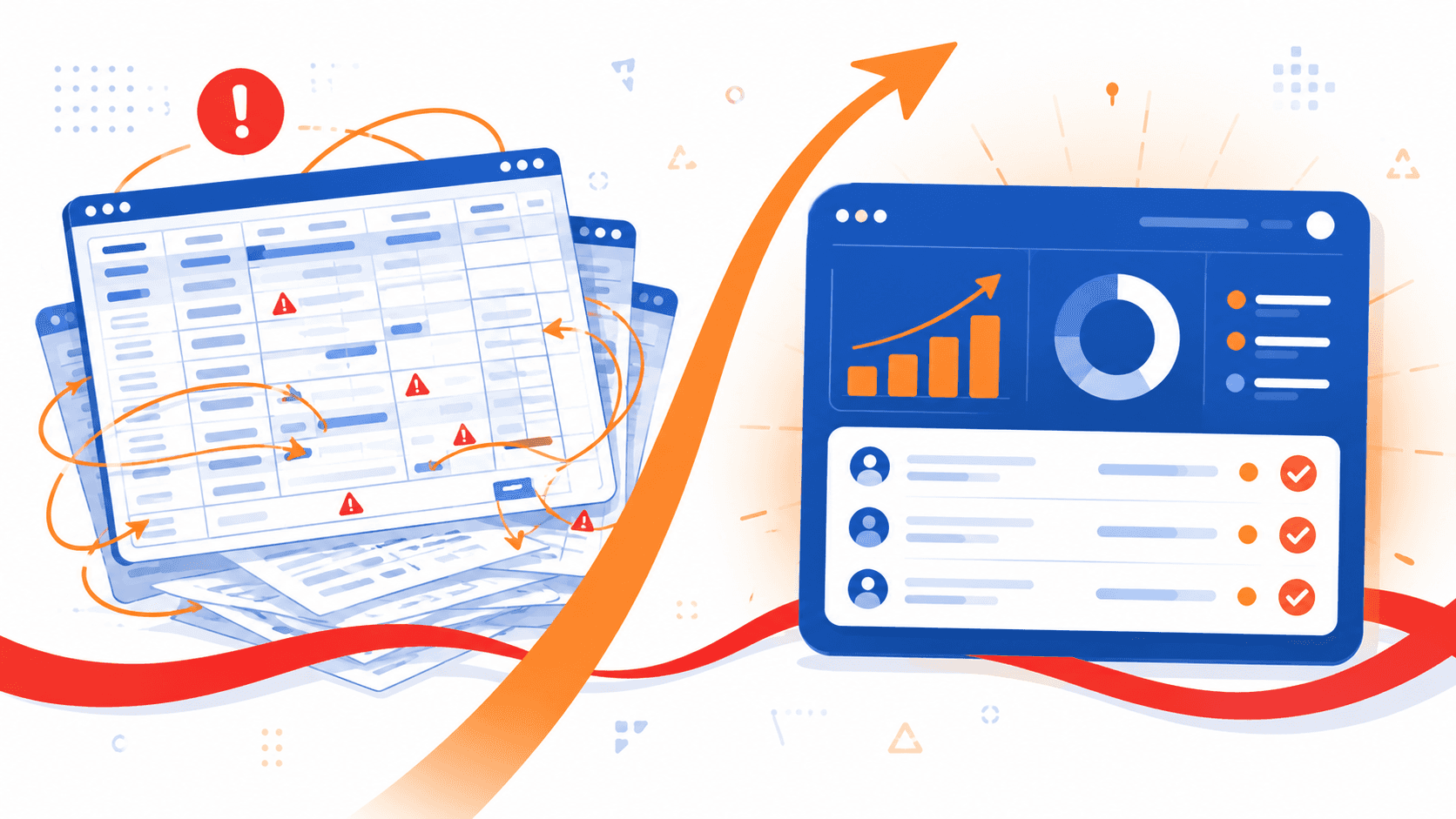
The shift usually happens gradually. A spreadsheet that once felt manageable becomes harder to maintain. More people start accessing it. Multiple versions appear. Updates are missed or overwritten.
What used to be a simple tool turns into something fragile.
Teams begin to spend more time maintaining spreadsheets than actually using them. Information becomes inconsistent. Important details are buried in tabs, formulas, or outdated files.
At this point, the issue is no longer about the tool itself. It is about the growing complexity of the business.
Signs your startup has outgrown spreadsheets
One of the clearest signs is when visibility starts to drop. Teams are no longer sure which version of a file is accurate. Managers need to double-check information before making decisions. Simple questions take longer to answer because data is spread across multiple sheets.
Another sign is when processes become manual and repetitive. Tasks such as updating records, tracking progress, or managing approvals require constant effort. Instead of enabling work, spreadsheets begin to create overhead.
As teams grow, coordination also becomes harder. Spreadsheets do not reflect real-time changes easily, and they are not designed to handle workflows across multiple people. This leads to delays, miscommunication, and missed updates.
The hidden cost of staying too long
Many startups delay switching because spreadsheets feel “good enough.” However, the cost of staying too long is often underestimated.
Decisions are made using incomplete or outdated data. Planning becomes reactive rather than proactive. Teams spend time fixing errors instead of moving work forward.
Over time, these inefficiencies compound. What starts as small friction can turn into a significant operational bottleneck.
The challenge is that this cost is rarely visible in one place. It appears in missed deadlines, duplicated work, and unnecessary complexity.
Why timing matters more than perfection
Startups often wait until things feel completely unmanageable before introducing proper systems. By then, workflows are already messy, and transitioning becomes more difficult.
The right time to switch is not when everything breaks, but when early signs of friction begin to appear. This is when a structured system can bring clarity without disrupting momentum.
Switching earlier allows teams to build good habits and workflows before complexity increases.
What “proper business software” actually means
Moving away from spreadsheets does not mean adopting overly complex systems. It means choosing tools that are designed to handle how work actually happens.
Proper business software connects different parts of operations. It allows teams to manage projects, people, time, and processes in a structured and consistent way. Information is updated in real time, workflows are clear, and data is reliable.
The goal is not to replace flexibility entirely, but to reduce the chaos that comes with manual management.
The advantage of connected systems over isolated tools
Some startups replace spreadsheets with multiple specialized tools. While this can solve individual problems, it can also introduce a new kind of complexity.
When tools are disconnected, teams still need to move information between systems. Visibility remains limited, and workflows become fragmented.
Connected systems, on the other hand, allow data to flow naturally. Projects, people, and time are linked, making it easier to understand how work is progressing and where effort is being spent.
This reduces manual effort and creates a more reliable operational foundation.
How Skapp supports the transition from spreadsheets
Skapp is designed to help startups move beyond spreadsheets without introducing unnecessary complexity. Instead of forcing teams to adopt multiple tools, it brings core business functions into one platform.
Teams can manage projects, track time, organize employee data, handle leave, manage documents, bill customers, and oversee operational workflows in a single system. This reduces the need for manual tracking and keeps information consistent across the business.
Because everything is connected, teams gain better visibility and can make decisions with greater confidence.
Making the switch without slowing down
One of the biggest concerns startups have is that switching systems will slow them down. In reality, the right transition improves speed by removing friction.
The key is to start simple. Focus on the areas where spreadsheets are causing the most problems, and introduce structure there first. As the team becomes comfortable, workflows can expand naturally.
The goal is not to overhaul everything at once, but to create a system that grows with the business.
Building for the next stage of growth
Spreadsheets are a great starting point, but they are not designed to support long-term growth. As startups scale, the need for clarity, consistency, and connected workflows becomes more important.
Switching to proper business software is not just about replacing a tool. It is about preparing the business for its next stage.
The earlier this transition happens, the smoother that growth will be.
When should a startup stop using spreadsheets?
A startup should consider moving away from spreadsheets when they start becoming difficult to manage, when multiple versions appear, or when teams struggle to get accurate, real-time information.
Why do spreadsheets become a problem as teams grow?
Spreadsheets are not designed for real-time collaboration, structured workflows, or connected operations. As more people use them, they become harder to maintain, leading to errors, duplication, and reduced visibility.
Can startups continue using spreadsheets alongside business software?
Yes, many startups still use spreadsheets for specific tasks. However, core operations like projects, people, and workflows are better managed in structured systems that provide consistency and real-time updates.
What are the benefits of switching to proper business software?
Business software provides better visibility, structured workflows, real-time data, and improved collaboration. It reduces manual work and helps teams operate more efficiently as they scale.